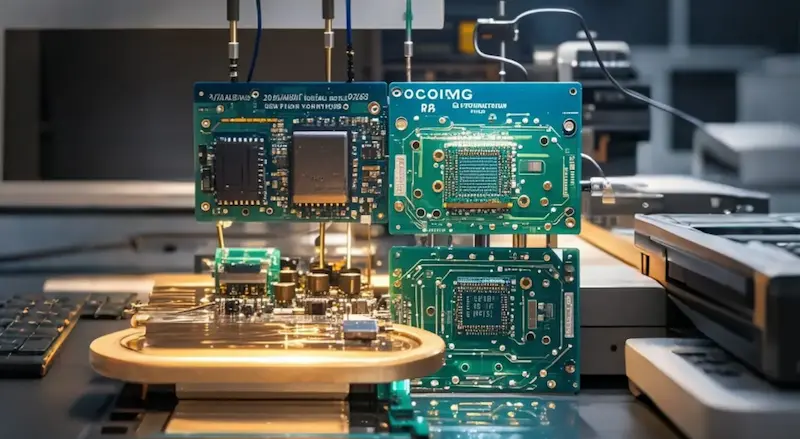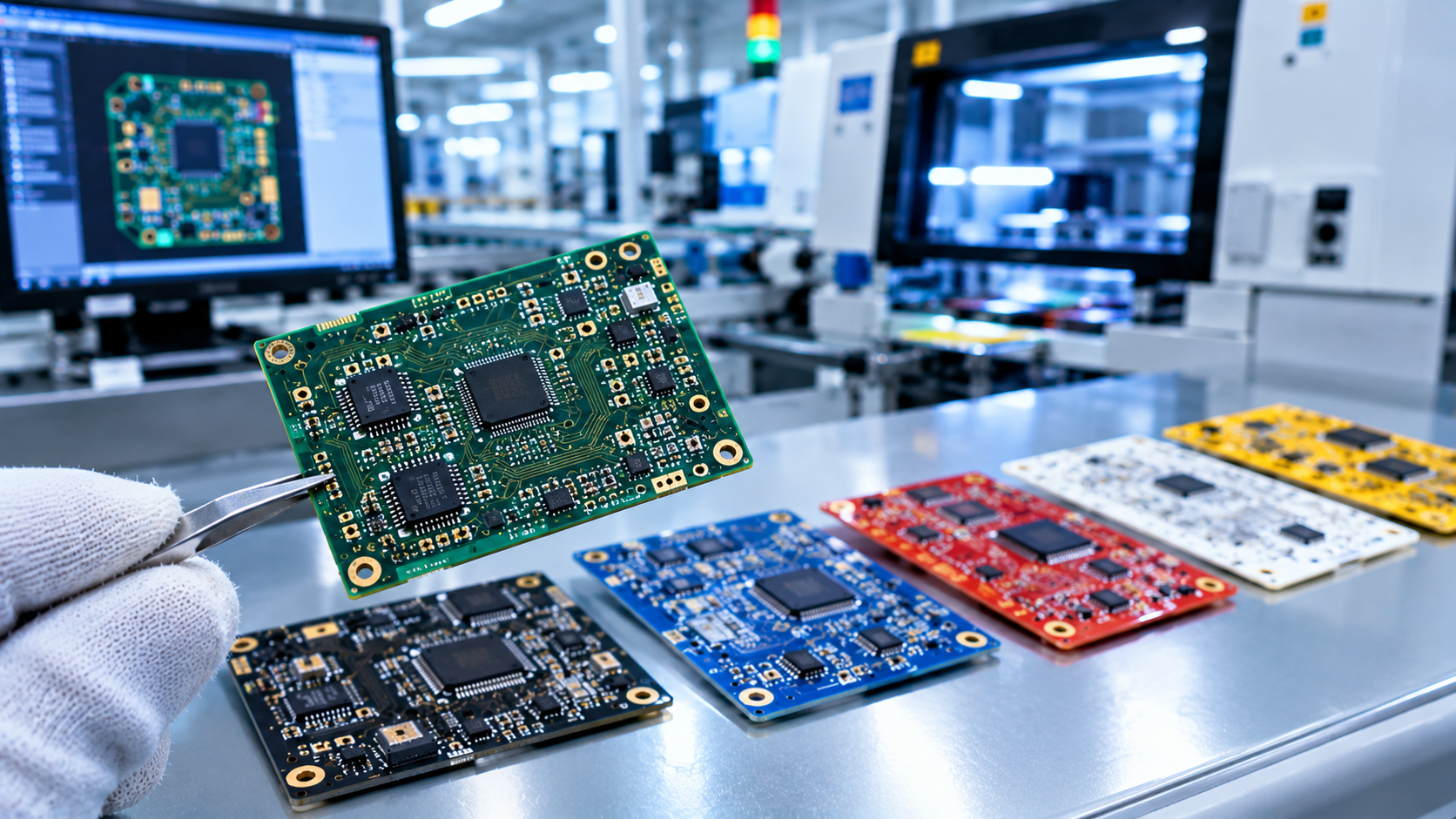
Introduction: PCB color is determined by the solder mask, and it is more than an aesthetic choice. Color affects AOI inspection, optical alignment, manufacturing cost, lead time, and reliability. This article explains the characteristics of green, white, black, blue, red, and yellow solder masks—and how to choose the right one for your application.
Description: Based on AnyPCBA's small-to-medium volume PCB and PCBA manufacturing experience, this guide explains how PCB color affects manufacturability, inspection, cost, and reliability—and how to choose the right solder mask color for R&D, consumer, medical, and automotive applications.
When you pick up a PCB, the first thing you see is the color of the board surface. That color is the solder mask.
PCB coloring pigment is a hardened resin. The base resin is nearly transparent and colorless, and green and other colors are all created by mixing in pigment powder. The color is applied to the PCB through screen printing. Common colors include green, black, blue, yellow, purple, red, and brown. Some manufacturers have also developed white, pink, and other colors.
But color is not just an aesthetic choice. It directly affects manufacturability, inspection efficiency, cost, and lead time. This article explains the engineering and manufacturing logic behind PCB color selection.
Green is the most popular color. There are several reasons:
High clarity: green contrasts sharply with white text, improving readability
Reduced glare: green surface treatment reflects less light, helping reduce glare
Better equipment recognition: AOI and optical alignment equipment recognize green backgrounds more effectively
Lower cost: green solder mask processes are mature, and procurement costs are lower than other colors in high-volume production
White PCBs look clean and crisp in various environments and are becoming increasingly popular. But they tend to hide traces, so they are not the first choice. White PCBs contrast particularly well with black silkscreen, making them suitable for high-contrast applications.
Yellow PCBs were more common in the past but are less practical today. They can quickly meet different needs for style, cleanliness, and visibility, but have one clear drawback: poor contrast with traces and silkscreen.
Blue PCBs are considered thick boards used for labels, because they provide significant silkscreen contrast. Blue PCBs work well when mounted on LCDs, because they do not produce sharp contrast edges and bright background colors.
Red PCBs offer excellent visibility and clearly define the contrast between traces, planes, and empty areas. Silkscreen stands out beautifully against red PCBs, which is why many manufacturers favor them.
Black PCBs are as popular as white PCBs, producing low contrast that makes it easy to mark important components. But the main drawback is that specific details may catch light and cast small shadows, making tracing difficult. In addition, black PCB is a mixture of cobalt and carbon, so conductivity may be relatively poor.
Green became mainstream not by accident, but through a combination of process maturity, cost, inspection compatibility, and reliability.
1. The tradition of glass epoxy resin material
Glass epoxy resin is the material used to manufacture PCB solder masks. This material was historically green, becoming the standard color for all assemblers using the same glass epoxy resin. Although other colors were later introduced, assemblers still prioritize green.
2. Contrast with white printed text
Assemblers find scanning green circuit boards simple and time-saving because they are already accustomed to and familiar with the color. Compared to other colors, green puts less strain on the eyes during scanning.
3. Military applications
The military requires suppliers to provide green circuit boards, and these suppliers also supply other customers. As a result, not only assemblers, production line workers, and other customers consider green—the military also accepts green circuit boards.
4. Solder mask exposure rate
Circuit boards require higher soldering rates. Dark colors such as blue, white, or brown have high pigmentation and therefore dark solder masks, but white and black solder masks have high exposure rates. Green provides dark shading for worker exposure and high tolerance in design.
5. Better machine recognition
Electronic products all go through board fabrication and component placement and soldering. During SMT soldering, inspection must be performed through solder paste, placement, and bottom-side AOI. These processes all require optical positioning and calibration—green PCB backgrounds are recognized more effectively by the equipment.
6. More comfortable for operators
Some inspection processes rely on human observation. Staring at boards under strong light is easier on the eyes with green PCBs.
7. Lower production cost
Green has wide application. In high-volume production, the same color coating can be used, reducing production line costs. Green coating procurement costs are also lower. As a result, green is the most common resist and has advantages in manufacturing cost and delivery time.
8. Relatively environmentally friendly
Scrap boards do not release toxic gases during high-temperature recycling. Other PCB colors, such as blue and black, are mixed with cobalt and carbon respectively, and because their conductivity is weaker, there is a risk of short circuits.
Colors that are too dark increase the difficulty of board repair and make the process harder to control.
Take black boards as an example. Black boards are most prone to problems in production processes and raw material ratios. A slight misstep can cause obvious color variation, leading to higher defect rates. Black circuit board traces are difficult to distinguish, which increases the difficulty of later maintenance and debugging. Many PCB factories avoid black PCBs for this reason.
For high-temperature applications, black PCBs are also not recommended, because black PCB may cause silkscreen to discolor.
As a factory focused on small-to-medium volume PCB and PCBA manufacturing, AnyPCBA has accumulated years of experience in color selection.
Our manufacturing capabilities cover 2–64 layers, including HDI, rigid-flex, and high-frequency hybrid. We hold ISO 13485 (medical) and IATF 16949 (automotive) certifications.
For PCB color selection, our DFM review provides recommendations based on the customer's application:
R&D prototyping and functional verification: green is preferred. Mature process, stable lead times, controllable cost, and easy AOI inspection and debugging.
Consumer electronics exterior parts: white, black, or blue can be selected based on product design, but solder mask process windows and color variation control requirements must be confirmed in advance.
Medical and automotive high-reliability applications: green is preferred. Green solder mask offers the best process stability and inspection compatibility. Dark solder masks carry higher reliability risk in high-temperature and high-humidity environments.
Scenarios requiring high-contrast silkscreen: black or white can provide better visual effects, but you need to accept the increased difficulty of trace tracing.
High-volume production: green has clear advantages in procurement cost and lead time.
Our engineers help you judge how color selection affects manufacturing and inspection at the design stage, so your boards are not only visually appealing, but stable and reliable to produce.
If you're working on PCB design, or want to learn more about our solder mask capabilities, contact us through our website.
What challenges have you encountered in PCB color selection? Share your experience in the comments.