Introduction: This article covers the causes of BGA pad lifting and solder bridging, a 6-step repair method, stencil design optimization, reflow profile adjustment, and dry film applications in rework.
Description: Based on AnyPCBA's small-to-medium volume PCBA manufacturing experience, this guide helps engineers control BGA soldering quality from design, material, process, and inspection perspectives—reducing bridging and pad lifting failures.
Excessive solder paste volume
Improper stencil aperture ratio
Too-fast reflow ramp rate, causing solder paste splatter
Insufficient flux activity or excessive residue
Placement offset or excessive placement pressure
Hot Air Gun Repair
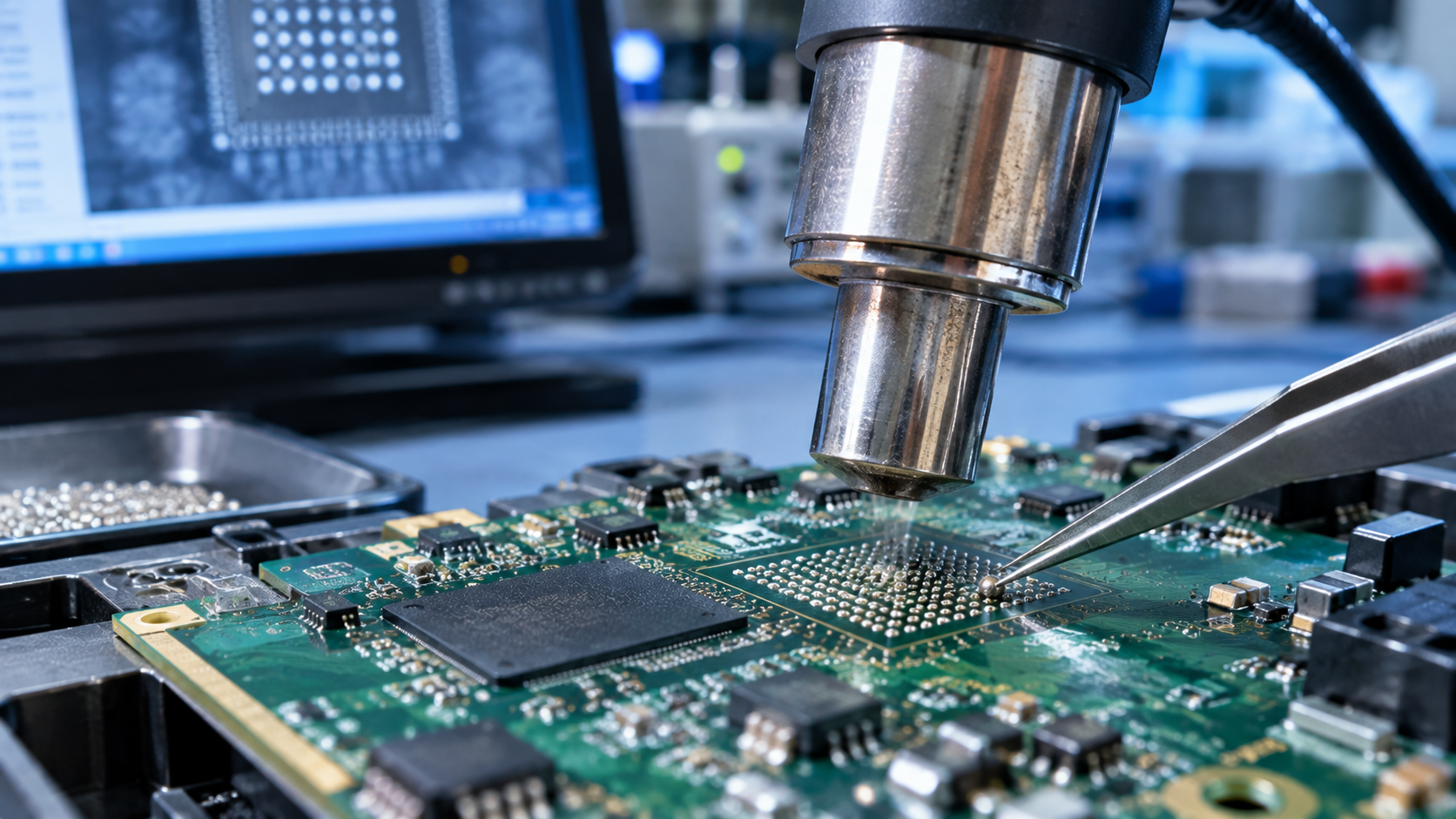
Use a 245°C hot air gun to locally heat the bridged area, then gently separate the solder balls with fine-tipped tweezers. Keep the PCB stable during operation to avoid secondary damage.
Solder Wick Treatment
For light bridging, use solder wick with an iron (around 300°C) to remove excess solder.
Flux Adjustment
Choose low-residue, high-activity flux, such as the JDB-200 series, to effectively reduce bridging risk.
Keep stencil thickness within 0.1 mm; recommended aperture ratio 1:0.9
During reflow, keep ramp rate ≤2°C/s to avoid solder paste splatter
Complete placement within 2 hours after printing to avoid solder paste oxidation
Stencil apertures should be slightly smaller than the pads (90% ratio recommended)
Laser-cut stencil accuracy can reach ±5 μm, effectively reducing excess solder paste
Use Type 4 solder paste with finer particles, suitable for high-density BGA
Complete placement within 2 hours after printing to avoid solder paste oxidation
Preheat stage (120–180°C): control time at 60–90 seconds to allow full flux volatilization
Peak temperature: recommended 245°C, avoid excessive reflow that causes over-fusion of solder balls
X-Ray Inspection
Confirm the bridging location to avoid blind operation. AnyPCBA performs 100% X-Ray inspection on BGA devices in small-to-medium volume production, ensuring solder joint quality is traceable.
Microscope Observation
Check whether solder balls are deformed or stuck together.
Local Heating Method
Use a hot air gun (240–250°C) aimed at the bridged area; once the solder softens, adjust with tweezers.
Solder Paste Rework
If bridging is severe, re-balling is required. A BGA rework station with precise temperature control offers a higher success rate.
Regularly check whether the stencil is deformed or clogged
Use high-precision placement machines to reduce offset risk
Adjust the reflow profile: Lead-free solder requires a peak temperature around 250°C, but with a gentle ramp (1.5–2°C/s)
Optimize flux: Choose high-activity flux, such as JDB-300, to improve solder flow and reduce bridging
Excessive temperature causing over-fusion of solder balls
Stencil aperture too large, leading to uncontrolled solder paste volume
Clean the pads: Remove residual flux with anhydrous ethanol
Local heating: Hot air gun at 245°C, air speed at level 2, evenly heat the bridged area
Separate the solder balls: Gently push the solder balls with fine-tipped tweezers to reposition them
High-precision hot air gun with temperature control
Fine-tipped tweezers
X-Ray inspection equipment
BGA rework station
Keep the PCB stable during operation to avoid secondary damage
Perform X-Ray inspection after repair to ensure no cold solder joints or bridging remain
Dry film is mainly used in BGA rework for local protection and flux assistance:
Local protection: Apply dry film around the rework area to prevent flux from contaminating other solder joints
Flux assistance: Some dry films have fluxing properties that help solder balls reposition
Operation tips: Ensure no bubbles when applying dry film; remove promptly after heating to avoid residue
AnyPCBA has over ten years of experience in small-to-medium volume PCB manufacturing and PCBA assembly, and holds ISO 13485 (medical) and IATF 16949 (automotive) certifications. For BGA devices, we provide:
DFM review: Identify BGA soldering risks at the design stage
100% X-Ray inspection: Ensure solder joint quality is traceable
High-precision placement and reflow: Reduce bridging and offset
Rework support: BGA rework and failure analysis services
Component sourcing: Assess BOM risks and find alternatives
Our manufacturing capabilities cover 2–64 layers, including HDI, rigid-flex, and high-frequency hybrid, specializing in 5–5000 pcs small-to-medium volume production, with no MOQ for prototype boards.
BGA soldering quality is critical to PCBA reliability. Whether it is pad lifting, solder ball bridging, or dry film application in rework, it requires systematic control from design, material, process, and inspection.
If you encounter issues in BGA soldering or PCBA processing, AnyPCBA has over ten years of experience in small-to-medium volume PCB manufacturing and PCBA assembly. Our engineers check BGA soldering risks during DFM review, helping you anticipate process issues at the design stage. We also provide component sourcing services to assess BOM risks, find alternatives, and optimize procurement costs.
Our manufacturing capabilities cover 2–64 layers, including HDI, rigid-flex, and high-frequency hybrid.
If you have BGA soldering, PCBA processing, or PCB manufacturing needs, please contact us through our website.