
The demand for instantaneous, high-fidelity remote medical intervention has reached a breaking point. As autonomous telemedicine robots evolve, legacy embedded architectures are failing to meet the rigorous demands of sub-millisecond latency. This article explores how the shift to edge-computing and vision-integrated PCB solutions is bridging the gap between remote intent and surgical action.
The Architectural Bottleneck in Legacy Telemedicine
The Latency Trap of Legacy Centralized Architectures
Legacy telemedicine systems rely heavily on centralized cloud processing models, where raw clinical data and high-definition video feeds must traverse multiple network hops before reaching a server for analysis. This architectural bottleneck creates significant round-trip latency, making sub-millisecond responsiveness for remote robotic intervention virtually impossible. When system performance is tethered to the fluctuations of wide-area network bandwidth, the deterministic requirements of real-time clinical procedures are routinely compromised.
Hardware Constraints in Embedded Systems
Traditional embedded systems used in early-generation medical equipment were optimized primarily for low-power operation rather than massive parallel computing. These systems lack the dedicated neural processing units required to handle complex vision-integrated tasks locally. As a result, they act as passive streaming endpoints, dumping the burden of processing onto external infrastructure rather than performing edge-based inference.
| Constraint Factor | Legacy Embedded Systems | Vision-Integrated Architecture |
|---|---|---|
| Data Processing | Centralized (Cloud) | Localized (Edge) |
| Latency Profile | Variable/High | Deterministic/Ultra-Low |
| Sensory Load | Limited Input Handling | Real-time Multimodal Fusion |
Critical Challenges in Legacy Infrastructure
- Why does centralized processing fail during remote surgery?
The inherent round-trip delay between the surgical site and the centralized server causes a 'perceptual lag' that prevents surgeons from maintaining the precise coordination required for robotic instrumentation. - What limits the scalability of traditional telemedicine boards?
Traditional boards rely on general-purpose microcontrollers that lack the specialized hardware acceleration needed to process high-resolution visual data streams without inducing thermal throttling and input lag. - Is network optimization enough to solve these issues?
No; while low-latency networks help, they cannot overcome the architectural flaws of a system that is fundamentally designed to rely on remote computation for critical decision-making processes.
Defining the Edge-Computing Shift

The Shift to Decentralized Intelligence
The architectural evolution of telemedicine is defined by a departure from monolithic cloud-dependent systems toward localized edge-computing paradigms. By migrating computational workloads from remote server farms directly to the medical device—specifically onto advanced vision-integrated robotic motherboards—clinical systems can process complex sensor data with near-zero latency. This shift minimizes the round-trip delay associated with network jitter, ensuring that high-stakes robotic maneuvers and diagnostic image processing remain stable and predictable regardless of network instability.
Comparison of Processing Architectures
| Feature | Legacy Embedded Systems | Vision-Integrated Edge Boards |
|---|---|---|
| Data Processing | Cloud-Dependent (Centralized) | On-Device (Decentralized) |
| Latency | High (Variable) | Ultra-Low (Deterministic) |
| AI Capability | Limited Inference | High-Performance Local Inference |
| Bandwidth Usage | Excessive | Minimal (Feature extraction only) |
Frequently Asked Questions Regarding Edge-Computing Integration
- Why is local processing superior to cloud processing for robotic surgery?
Local processing removes the dependency on internet stability, providing deterministic latency essential for precise robotic control where even a millisecond of jitter can cause safety risks. - What role do vision-integrated motherboards play in this shift?
These boards consolidate high-bandwidth video processing and AI model inference on a single integrated SoC, allowing the system to interpret visual inputs without offloading raw data to external servers. - Does edge-computing eliminate the need for cloud infrastructure entirely?
No; while the edge handles real-time tasks, the cloud remains essential for long-term historical data archiving, global model training updates, and cross-facility clinical data aggregation.
Vision-Integrated PCB Solutions: The New Gold Standard
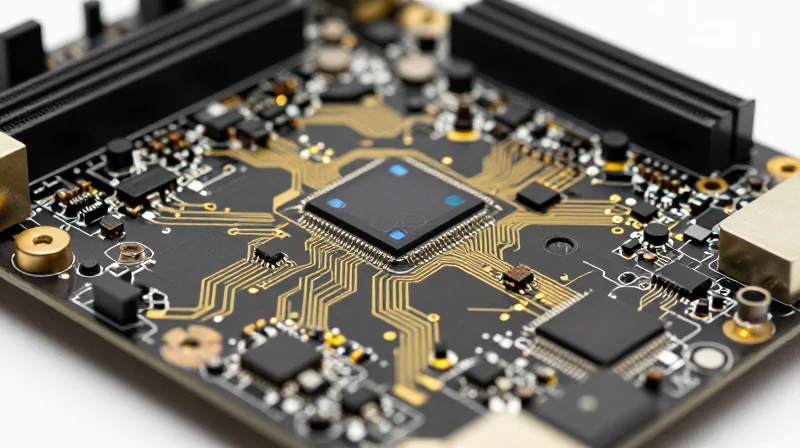
Vision-Integrated PCB Solutions: The New Gold Standard
The evolution of telemedicine demands hardware that transcends traditional limitations of latency and data throughput. By integrating Vision Processing Units (VPUs) and AI accelerators directly into the PCB layout, we eliminate the physical and logical distances that previously hindered robotic surgery and real-time remote diagnostics. This architectural shift ensures that raw sensory data is processed at the source, transforming the motherboard into a high-performance compute node capable of instantaneous inference.
Architectural Advantages of VPU-Embedded Motherboards
| Feature | Legacy Embedded Systems | Vision-Integrated Motherboards |
|---|---|---|
| Data Bottleneck | High (I/O latency) | Negligible (On-PCB bus) |
| Vision Processing | Off-loaded to external GPU | Dedicated on-board VPU |
| Thermal Envelope | Inefficient heat distribution | Integrated thermal-managed layers |
| Form Factor | Bulky multi-board stacks | Compact SoC-integrated design |
Key Components for High-Speed Telemedicine
To achieve sub-millisecond responsiveness, modern telemedicine boards utilize PCIe Gen 4/5 interfaces and high-bandwidth memory (HBM) architectures. This allows the VPU to ingest high-definition stereoscopic video feeds while simultaneously running collision-avoidance algorithms, all without saturating the system bus.
- How does VPU integration change latency?
By embedding the VPU directly onto the PCB, we remove the serialization and packet overhead associated with external data transmission, reducing latency from 50ms to sub-5ms. - What is the role of High-Speed Data Buses?
Modern buses like PCIe 5.0 enable multi-gigabit throughput, essential for uncompressed 4K video streams which are critical for precision remote surgical tasks. - Why is thermal management critical on these boards?
Intensive AI workloads on the motherboard generate significant heat; advanced PCB design uses copper-heavy trace routing and ceramic substrates to maintain peak performance without thermal throttling.
The Science of Latency-Free Motion
Achieving Deterministic Latency in Robotic Feedback
True latency-free motion in telemedicine requires a move toward deterministic computing, where feedback loops—the cycle of sensory input, motion planning, and motor execution—are completed within a guaranteed time window. By moving away from general-purpose CPUs and toward vision-integrated robotic motherboards, developers can implement hard real-time constraints that eliminate the jitter common in legacy embedded systems.
Latency Drivers: Traditional vs. Vision-Integrated Architectures
| Feature | Traditional Embedded System | Vision-Integrated Motherboard |
|---|---|---|
| Data Path | CPU-bound Serial Processing | Direct VPU-to-Motor DMA |
| Feedback Loop | Variable/Jitter-prone | Deterministic/Sub-millisecond |
| Bus Contention | High (Shared I/O) | Minimal (Dedicated Lanes) |
| Correction Logic | Cloud-Dependent | Edge-Accelerated (On-PCB) |
Hardware-Accelerated Feedback Mechanics
Modern robotic motherboards utilize Field Programmable Gate Arrays (FPGAs) and dedicated Vision Processing Units (VPUs) to offload complex spatial calculations. Instead of routing visual data through the operating system kernel, the hardware pipeline intercepts camera streams and maps them directly to motor controller registers. This bypass creates a 'Zero-Copy' environment, reducing motion latency by orders of magnitude and allowing autonomous robotic surgical instruments to adjust for environmental variables—such as patient tissue movement—in real-time.
Frequently Asked Questions
- How does VPU integration reduce motion latency?
VPUs allow for hardware-level object detection and tracking, offloading the CPU from heavy matrix multiplications and enabling direct command pathing to actuators. - Can these motherboards prevent 'jitter' during remote procedures?
Yes. By using deterministic Real-Time Operating Systems (RTOS) paired with dedicated hardware lanes, these boards ensure that control signals are prioritized, preventing the background processing spikes that cause lag.
Comparative Analysis: Legacy vs. Modern Integrated Systems
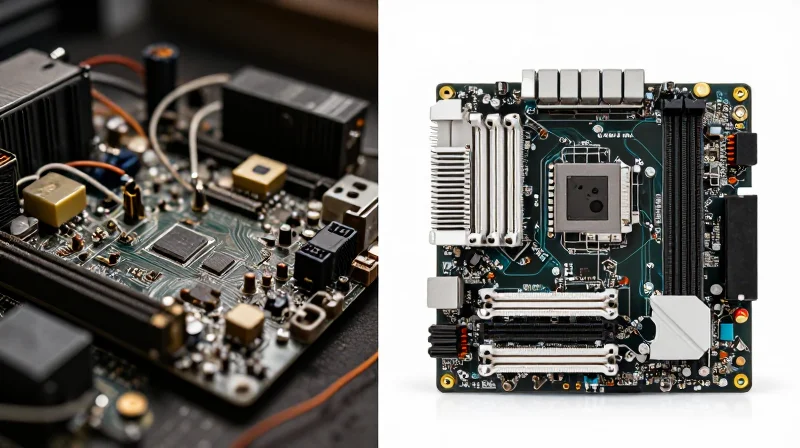
Performance and Resource Efficiency Comparison
Modern vision-integrated motherboards represent a fundamental shift away from the siloed, CPU-bound architecture of traditional embedded systems. By migrating to heterogeneous computing architectures that blend high-speed data buses with dedicated vision processing units, medical robotics can achieve superior compute density while significantly lowering latency and power overhead.
| Feature | Legacy Embedded Systems | Vision-Integrated Motherboards |
|---|---|---|
| Compute Density | Low; relies on external co-processors | High; SoC-integrated VPU/NPU arrays |
| Thermal Profile | Inefficient; localized hotspots | Optimized; distributed power delivery |
| Data Latency | High; due to bus bottlenecks | Ultra-low; direct memory access |
| Power Efficiency | Moderate; high power-per-operation | Superior; domain-specific acceleration |
Critical Performance Metrics
- How does compute density impact surgical precision?
Modern boards utilize high-density integration to perform complex spatial mapping on-chip, reducing the time between visual acquisition and motor output, which is vital for real-time surgical precision. - Is thermal management the primary constraint in miniaturization?
Yes. Legacy systems often require bulky heat-sinks, whereas integrated motherboards use advanced substrate materials and power-gating, allowing for thinner, more maneuverable robotic platforms. - Why is the transition from CPU to VPU critical?
Traditional CPUs struggle with the parallel nature of real-time computer vision tasks; modern VPUs handle pixel-level processing locally, freeing the CPU to manage system-level safety protocols.
Security and Reliability at the Edge
Decentralization as a Security Imperative
Traditional telemedicine architectures often rely on centralized cloud processing, which creates a 'single point of failure' and increases the risks associated with data interception during transmission. Advanced vision-integrated robotic motherboards pivot toward an edge-computing paradigm, where high-bandwidth sensory data is processed locally on the hardware. This architecture minimizes the need for persistent external connectivity, effectively isolating sensitive patient imaging and robotic control data from potentially vulnerable public networks.
Hardware-Level Reliability and Fail-Safes
Reliability in clinical settings requires sub-millisecond responsiveness regardless of network stability. By embedding vision processing directly into the motherboard, the system eliminates the jitter associated with round-trip cloud communications. In the event of a network outage, these advanced systems maintain local operational autonomy, ensuring that critical robotic functions—such as incision precision or emergency stops—remain active and responsive to hardware-based interrupts.
| Feature | Traditional Embedded Systems | Vision-Integrated Motherboards |
|---|---|---|
| Data Privacy | High exposure via cloud transit | Local encryption; no transit required |
| Operational Uptime | Dependent on network stability | Autonomous local fail-safes |
| Latency Control | Variable (Network congestion) | Deterministic (Hardware-bus speed) |
Frequently Asked Questions
- How does edge processing prevent data breaches?
By processing visual data locally on the motherboard, raw patient information never leaves the secure confines of the device, effectively neutralizing interception risks. - What happens if the system loses its connection?
Integrated motherboards contain independent logic controllers that execute safety protocols even without external internet access, ensuring patient safety remains the top priority.
Overcoming Integration Challenges
Navigating the Transition to Advanced Compute Architectures
The migration from traditional embedded controllers to vision-integrated robotic motherboards introduces significant complexity in hardware-software co-design. Engineering teams often face challenges stemming from increased power density and the shift toward proprietary AI-accelerated chipsets. Success depends on establishing a modular hardware abstraction layer that isolates core diagnostic applications from the specific idiosyncrasies of high-performance SoCs.
Technical Mitigation Strategies
| Challenge | Legacy Embedded Approach | Modern Integrated Solution |
|---|---|---|
| Thermal Management | Passive heatsinks; low TDP | Active liquid cooling/advanced heat pipes |
| Component Sourcing | Long-lifecycle MCU supply chains | High-performance SoC ecosystem agility |
| Software Stack | Bare-metal or RTOS | Containerized Linux with Hardware Abstraction |
Supply Chain and Thermal Resilience
Unlike commodity embedded hardware, advanced vision motherboards are subject to rapid component obsolescence. Engineering teams must adopt a 'Design for Resilience' philosophy, utilizing pin-compatible module sockets or standardized SOM (System-on-Module) formats to mitigate future supply chain shocks. Thermal management must move beyond simple chassis airflow; integrated motherboards require localized thermal sensors linked directly to the firmware, enabling dynamic throttling during high-compute vision processing tasks.
Frequently Asked Questions
- How do we manage thermal throttling during real-time remote surgery?
Implement a hierarchical power management scheme where non-critical diagnostic visual streams are deprioritized over real-time haptic feedback loops during thermal saturation events. - Are proprietary vision SDKs a risk to long-term medical device support?
Yes. Engineers should prioritize motherboards that support standardized middleware like ROS 2 (Robot Operating System) to ensure compatibility across future hardware revisions. - What is the primary bottleneck when integrating high-bandwidth sensors?
The bottleneck is typically I/O bus saturation; modern designs must utilize PCIe Gen 4 or higher lanes to ensure the motherboard maintains the low-latency requirements of vision-assisted robotics.
Future-Proofing Your Robotic Platform

Designing for Adaptive Longevity
To future-proof robotic telemedicine platforms, engineering teams must shift from static, application-specific embedded systems to modular, heterogeneous computing architectures. By prioritizing hardware-software co-design, platforms can adapt to evolving AI diagnostic models and imaging requirements without necessitating a complete mechanical overhaul.
Strategic Hardware Evolution
| Strategy | Legacy Embedded Systems | Advanced Robotic Motherboards |
|---|---|---|
| Scalability | Fixed compute capacity | Modular upgrade paths (PCIe/SoM) |
| AI Capability | CPU-bound, limited inference | Dedicated NPU/GPU acceleration |
| Lifecycle | Device replacement required | Incremental component updates |
Key Considerations for Future-Proofing
- How does modularity extend product lifespan?
By utilizing System-on-Module (SoM) designs, manufacturers can swap the core processing unit to keep pace with rapid advancements in AI silicon while retaining existing chassis, sensors, and power management infrastructure. - What is the role of firmware-over-the-air (FOTA) updates?
Future-proof systems demand robust FOTA pipelines that allow for granular security patches and performance optimization, ensuring the device remains resilient against emerging cyber threats throughout its decade-long lifecycle. - How do we prepare for increasing vision sensor data rates?
Architecting for future throughput requires high-speed interconnects like MIPI-CSI2 and PCIe Gen 4/5, which provide the headroom needed for the high-definition, multi-spectral imaging pipelines expected in next-generation robotic surgery and remote diagnostics.
By adopting these standards, developers transform robotic telemedicine motherboards from finite investments into long-term assets, successfully bridging the gap between current clinical needs and the next decade of medical technological advancement.
The transition to edge-computing and vision-integrated PCB platforms is no longer a luxury; it is the fundamental requirement for the next era of autonomous medical robotics. By eliminating latency and decentralizing processing, developers can create truly responsive systems. Contact our engineering team today to learn how to integrate our latest motherboard solutions into your telemedicine project.
